
Anúncios
Moving water is the true essence of trout pursuit for many anglers, as Bob Humphrey put it. Rivers test your read of flow, and Captain Experiences reminds us that patience and the right gear turn challenge into reward.
This short guide solves a common problem: bait that drifts, sinks, or snags too fast. You will learn how to keep offerings in the strike zone longer, cut hang-ups, and spend more time catching fish.
Here’s what to expect: learn to read current and structure, pick snag-resistant rigs, control drift with casting angles, and adjust tackle for bigger water. The tips apply to bait, lures, and fly setups by focusing on universal presentation control.
Season and day matter, so this guide stresses simple on-water checks like line angle, bottom contact, and drift speed. Follow the steps ahead, and you’ll see fewer lost rigs and more consistent hookups across small streams and larger channels.
Anúncios
Understand moving water so your bait stays where fish can eat it
Reading the push and pull of current helps you deliver bait where fish can eat it. Flow changes with obstacles, and those shifts create the calm seams and eddies trout use to feed. Pay attention to where fast water meets slow water—those are your target lanes.
How speed and depth change drift and sink
Faster flow increases drag on your line and can lift or sweep bait faster than you intend. Deeper, inside lanes slow the drift and give bait more sink time for a natural presentation.
Where snags hide and how to read the bottom
Snag zones include rock gardens, rubble transitions, tailouts below riffles, and woody debris lines. Sharp cracks, root wads, and mussel beds create a “grabby” bottom that wedges weights and hook points.
Anúncios
Use the rod and line to feel the bottom: smooth taps mean gravel, heavy thuds signal boulders, a sticky pull-and-stop hints at wood or crevices, and sudden dead weight often means a wedge.
How seams and eddies protect your presentation
Seams form where fast and slow flows meet. Bait that rides the softer edge of a seam travels naturally while avoiding the hardest push that pins rigs into the bottom.
A simple on-water check: watch your line angle and drift speed. If your bait races past foam or bubbles, it’s too high or caught in the main push. Start wide in the seam, then work closer only after you confirm depth and bottom type.
“Water flows until it meets an obstacle and then flows around it, creating calmer pools/eddies downstream where trout hold and feed.”
Timing matters: allow extra time on upstream or up-and-across casts so baits reach the feeding level before they enter the calm pocket. Fish conserve energy by sitting in soft water and letting prey come to them—your job is to place bait in that lane without dragging it through the snaggiest bottom.
River fishing techniques for reading current, structure, and fish-holding water
Good anglers break water reading into steps: spot speed changes, look for depth clues, then find shelter before choosing a presentation.
Current breaks and downstream pockets
Boulders and clusters of rocks create calm pockets below them. Fish rest here to save energy and dart into the faster flow to eat.
Surface clues to hidden structure
Scan for swirls, odd waves, and soft boils. These signs often mark submerged ledges, wood, or rock piles that hold prey and game fish.
Bends, riffles, and cover
Outside curves usually run deeper and faster; they offer oxygen-rich spots but raise snag risk. Inside bends collect debris and food, so fish the seam where slow meets steady current.
- Riffles: work micro-pockets behind small rocks first, then target lies downstream.
- Wood tangles: present bait along the edge, not inside, to avoid losing gear.
Tip: on unfamiliar water, prioritize obvious breaks, bends, and surface anomalies—these are the highest-percentage spots to cast.
Choose tackle and rigs that reduce snagging and bait loss in current
Choosing the right setup cuts snags and keeps your offering in the strike zone longer.
Start with rods and line that match the flow. In faster currents, a stiffer rod and thicker, abrasion-resistant line help steer fish and pull rigs free. In slower water, lighter rods and thinner line improve drift and sensitivity.
Hook selection matters. Pick sizes that match your bait and target fish. Bait-holder hooks work well for natural baits, while octopus or circle styles reduce deep hang-ups on rocky bottom.
| Condition | Rod/Line | Hook/Size | Weight Strategy |
|---|---|---|---|
| Fast currents | Medium-heavy rod, abrasion line | Strong hook, medium size | Sliding sinker or three-way, just enough to hold bottom |
| Moderate flow | Medium rod, 8–12 lb line | Octopus/circle, matched to bait | Split-shot above hook, light contact |
| Slow water | Light rod, thin line | Smaller hook to match forage | Minimal weight, let bait swim naturally |
| Snaggy bottom | Stronger rod, abrasion line | Turned-in point to reduce wedging | Dropper or mid-line weight, avoid plowing |
Tune your setup by starting light and adding weight until you feel occasional ticks on the bottom. If snags rise, back off weight or try a different lane.
- Check line angle before you change spots.
- Adjust weight and hook type to match current and bottom.
- Use smaller lures and baits when structure is tight.
Quick checklist: line, rods, hook size, weight, drift lane. Fix these things and you’ll save more gear than by moving spots.
Use casting angles and drifts that keep bait off the rocks and in the strike zone
Adjusting your cast angle is the quickest fix to keep baits away from jagged structure and into the soft lanes where prey waits. Cast slightly upstream of your target to buy extra time for sink and natural presentation.
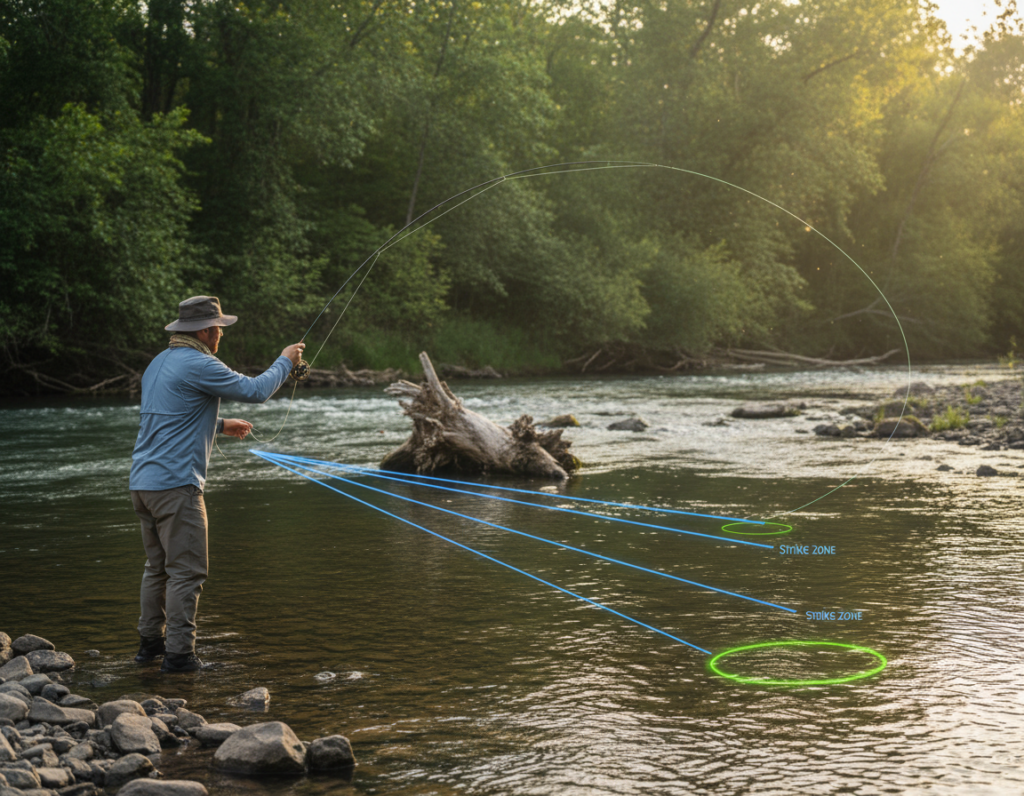
Upstream casts that buy sink time
Cast well above the pocket, then mend to remove line belly. Raising the rod tip slows drag and lets the bait drop into the feeding depth before it reaches the seam.
Cross-current for spinners and streamers
Fish spinners and streamers across the flow so they track naturally. Control retrieve speed so lures work without being swept into snag lines.
Controlled drifts along seams and edges
Pick a seam, cast just upstream of it, and follow the drift with your rod tip. Lead the drift with a slight downstream line angle and lift before the bait hits the heaviest structure.
Approaching cover without donating gear
Fish close to wood or logjams with short, accurate casts. Plan an exit—lift and reel on command—so baits tempt fish near cover but don’t finish in the tangle.
- Choose your lane, cast upstream, mend, and follow the drift.
- Use parallel, short casts along the bank in high or pushy water, keeping bait in the 1–3 feet of softer edge flow.
- Watch line for subtle ticks or sideways movement; that helps you tell a bite from a snag.
Adapt to big rivers, changing weather, and high water without losing gear
Big waterways hide sudden depth shifts that can chew through your tackle in minutes. Use maps and apps to avoid walking into costly spots. Mapping is the first step on any trip to larger channels.
Map it first: bathymetry, apps, and Google Earth
Open bathymetric layers or Google Earth and mark depth breaks, islands, piers, and bars. Note deep pockets and abrupt ledges before you cast.
Present tense workflow: identify channel edges, flag bridge pilings, and save access points on your device. This intel shows likely fish-holding areas and risky structure.
High, fast water: where fish and your bait move
After rain, water clarity, speed, and debris change for days. In high flows, fish hug the bank, eddies, and cover.
Fish tighter to sheltered spots with shorter casts, controlled drifts, and stronger terminal gear to handle floating debris.
“Plan your casts from the up-current side of a depth change and fish the seam where speed shifts.”
- Translate maps to position: start up-current of depth changes, fish the softer seam, not the fastest trough.
- Avoid steep ledges and rock piles to cut snag time and re-rigs.
- Target protected types of spots first: behind islands, downstream of wing dams, inside bends, and slack near bridge pilings.
Result: better planning saves gear and improves your catch because you spend more time fishing productive places and less time fixing rigs.
Conclusion
Close your session by working seams and edges where fish wait, not by chasing fast water.
Combine current reading with snag-resistant rigs and controlled drifts to keep bait and lures in the strike zone. That is the surest way to stop frequent re-rigs and save time on the water.
On each new run: identify current breaks, confirm depth, pick the right weight, choose your casting angle, then manage line through the drift. This mental checklist helps anglers stay focused and efficient.
Adapt as conditions change—higher flows or debris mean fish move to protected places. Pick two or three high-probability spots and fish them thoroughly.
Result: less gear loss, more productive time, and a higher catch rate across a lot of real-world river scenarios.



 English
  Spanish