
Anuncios
Can one routine trip between lakes carry a hidden threat that reshapes whole basins? This question matters because the Great Lakes hold more than 21% of the world’s surface freshwater and millions of people visit them each year.
A recent study tracked patterns of 6.5 million licensed anglers who average about 30 trips per year. Their movement creates pathways for organisms and leads to costly management efforts across states and regions.
This report uses research and modeled travel paths to show how simple habits — wet lines, damp gear, or boats moved between lakes and streams — can spread problems. It lays out clear steps for prevention and gives managers practical information to reduce impacts.
The Ecological Crisis of Aquatic Invasive Species
From Europe to North America, the arrival of foreign aquatic life has forced costly responses and changed native communities.
The scale of the problem is stark. Europe hosts about 14,000 alien records, while North America lists over 50,000. These counts reveal how connected trade and travel have let aquatic invasive species reach new basins.
Anuncios
Impacts are both ecological and economic. Management and control efforts now top an estimated $100 billion per year across affected regions. That money covers monitoring, removals, and restoration.
The biological consequences can be permanent. Each new arrival can change which fish and invertebrates thrive, alter food webs, and disrupt nutrient cycles.
- Global connectivity speeds the spread into freshwater and coastal systems.
- Once established, removals are expensive and often incomplete.
- Vigilant monitoring and proactive management reduce long-term harm.
Understanding the Role of Invasive Species Awareness Fishing Anglers
Understanding how everyday choices by recreational fishers shape ecosystem risks helps target practical solutions.
Anuncios
The Scope of the Problem
A study of 308 participants on the Pere Marquette River found that 52% reported awareness of the New Zealand mudsnail. That awareness did not always lead to different actions at the water’s edge.
Millions of people moving between lakes and streams create many high-risk pathways. Boats, boots, and wet lines can carry tiny organisms from one basin to another.
Identifying High-Risk Behaviors
Even well-meaning fishers may transport aquatic invasive material on gear. Common problem points include:
- Wet lines and reels that hold mud or eggs.
- Boots and waders with clinging matter between uses.
- Live wells and bait containers that retain water and organisms.
Effective outreach must close the gap between knowledge and action. Future work should test which information changes daily behaviors and reduces spread.
Mapping the Movement of Recreational Anglers
A large-scale travel map turns millions of license records into a tool for predicting where new aquatic arrivals may appear.
The study tracked 6.5 million licensed anglers across 12 states to build a spatial model of movement.
Researchers analyzed data from 1,042 counties and 66 watersheds to find frequent links between the Mississippi River and the Great Lakes basin.
Key routes included trips through New York and regions near the Ohio River, showing how connected waterways can speed spread.
Spatial analysis identified specific pathways where targeted biosecurity work will have the most impact. These corridors often repeat year after year.
“Mapping participant movement reveals where small interventions can reduce large-scale transfers.”
- Large data sets convert routine travel into predictive maps.
- County- and watershed-level detail pinpoints high-risk connections.
- Results inform outreach, inspections, and cleaning stations in priority areas.
The Hidden Risks of Wading Gear and Equipment
Small items of gear can carry big risks when moved between waterways. Many everyday tools trap mud, eggs, and tiny organisms that survive transport and colonize new areas.
Wader Material Risks
Felt-soled boots cling to mud and plant fragments. That material can carry zebra mussels or other microscopic life. In one survey, 27% of anglers still used felt soles while 44% cleaned their waders between trips.
Those numbers show a clear gap. Replacing felt with rubber or neoprene soles reduces the chance of transfer and the need for frequent cleaning.
Live Well Contamination
Live wells and bait containers often retain water and organisms after a trip. Leftover water provides a direct route for aquatic invasive species to move between lakes and streams.
Emptying and drying wells, and using treated water, cuts that pathway. A simple rinse and drain protocol is effective at lowering spread risk.
Trailer and Boat Transport
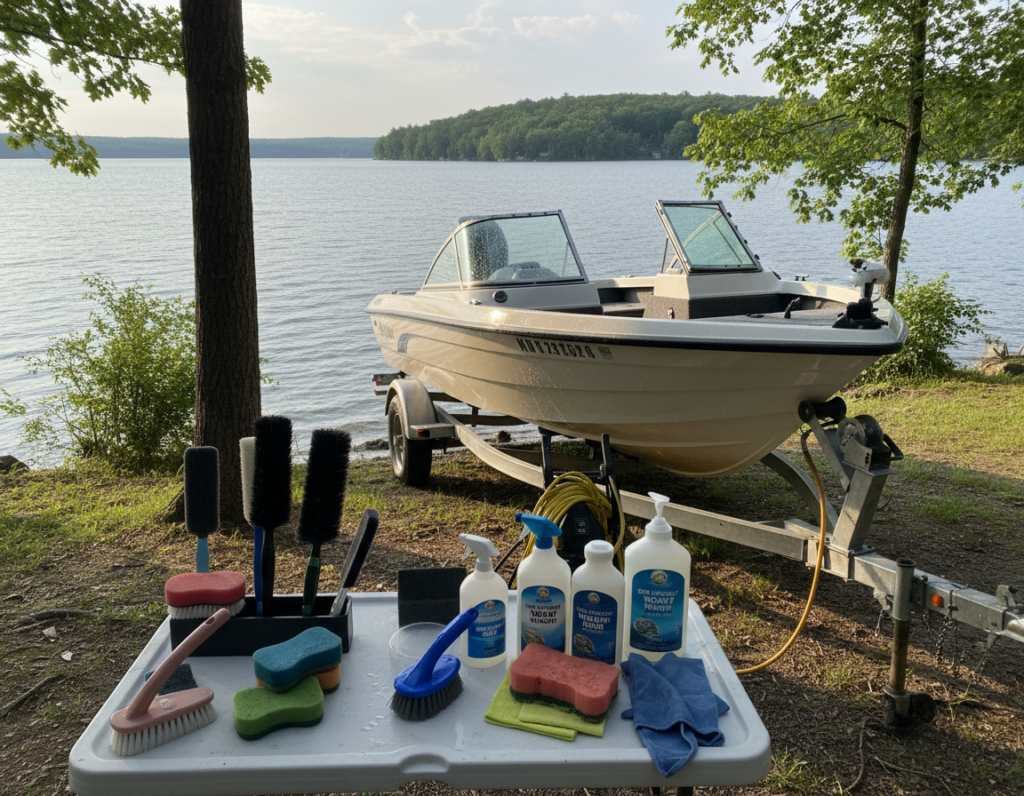
Trailers, hulls, and bilges trap debris and water that hide organisms. Moving a boat without proper decontamination can introduce new life into a pristine area.
“Standardized cleaning steps at launch sites can stop many transfers before they start.”
- Inspect and remove visible material.
- Drain all pockets of water and dry equipment thoroughly.
- Adopt consistent decontamination protocols for gear and boats.
Why Traditional Outreach Often Fails to Change Behavior
Many outreach campaigns assume facts alone will change habits, but routine choices at the launch often tell a different story.
The study found that 52% of anglers knew about the New Zealand mudsnail, yet only 44% cleaned their waders between trips.
This gap shows that simple information does not always change on‑the‑ground behaviors. Signs and brochures can inform, but they rarely remove the small barriers that stop action.
- People may not see their own gear as a vector for aquatic invasive species.
- Cleaning takes time, space, or equipment that is not always available at launch sites.
- Messages that do not fit local routines fail to stick.
“Bridging the gap requires targeted work that removes friction and makes good practice the easiest choice.”
Programs that combine timely information with practical tools — on‑site decontamination, clear step‑by‑step prompts, and social nudges — show the most potential to change behaviors across lakes, streams, and boats.
Analyzing the Impact of New Zealand Mudsnail Proliferation
The New Zealand mudsnail’s rise is a striking example of how a tiny organism can change whole freshwater systems.
High densities—reported up to 500,000 per square meter in the western US—show this mollusk can dominate benthic communities and displace native fish species quickly.
Life History Traits Facilitating Transport
The mudsnail can seal its operculum and survive for days on damp gear. That trait makes transport on boots, waders, and gear more likely than for many other aquatic invasive species.
First found in the Snake River in 1987, these animals adapted to varied water conditions and have spread across wide areas since that year.
A single individual can start a new population. This fact underlines why decontamination protocols are essential at launch points and between trips.
“Understanding the mudsnail’s biology helps managers design targeted actions to slow spread.”
- High reproductive output lets populations explode in short order.
- Durable shells and dormancy behavior aid survival on gear.
- Research and monitoring data guide where cleaning stations and outreach will do the most good.
The Connection Between Fishing Trips and Biological Spread
Millions of routine trips link lakes, rivers, and streams into a web of potential biological transfers.
The recent study used travel data from 6.5 million licensed anglers who average about 30 trips per year. That frequency creates countless opportunities for aquatic invasive species to move between basins.
Links between the Mississippi River and other major basins show how personal travel bridges previously isolated water. Movement of boats and gear between the Ohio River and nearby waterways is a confirmed driver of new arrivals.
Each outing can be an event that contributes to long-term spread when lines, boots, or live wells are not cleaned. The cumulative effect of millions of trips magnifies local risks into regional change.
- High trip frequency multiplies pathways for transfer.
- Boat and gear movement links distant waters quickly.
- Simple decontamination at launch points reduces spread.
“Targeting the most-traveled corridors yields the biggest return for prevention.”
Evaluating Current Biosecurity Protocols for Inland Waters
Biosecurity rules at inland launch points vary widely, creating gaps that allow organisms to hitch rides between waters.
The recent study that covered 12 states, 1,042 counties, and 66 watersheds shows how uneven protocols are. States such as New York follow different checklists and cleaning steps than nearby areas. That patchwork weakens prevention across the region.
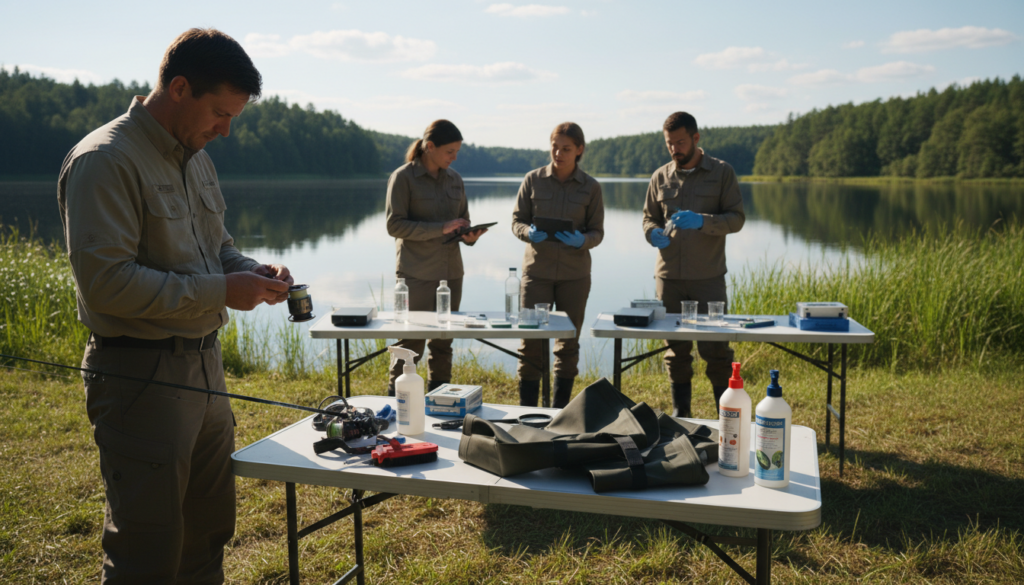
Evaluations must test whether current measures really stop the spread when lines, boots, or live wells move between lakes and streams. The research indicates many local efforts fall short of the scale created by frequent trips.
Standardizing management and using better data will close gaps. Uniform, science‑based rules can make compliance easier and reduce variability in enforcement.
“Consistent protocols across states yield stronger prevention and lower long‑term costs.”
- Audit current protocols and compare outcomes by state.
- Expand monitoring to cover high‑traffic counties and watersheds.
- Adopt common cleaning steps and clear public information at launches.
Challenges in Regulating Recreational Fishing Vectors
Managing the many small trips that link inland water bodies presents a regulation problem far different from commercial shipping.
Millions of recreational boats and day users move between lakes and streams each year. That volume creates a diffuse network that is hard to monitor.
Comparing Commercial and Recreational Regulation
Commercial shipping uses clear checkpoints and ballast rules, so compliance can be audited and enforced.
Recreational fishing relies on millions of individual decisions. Boats, boots, and wet lines travel unchecked across county and state borders.
“A system built for ships cannot simply scale down to millions of small craft.”
- Ballast management at ports is straightforward; cleaning millions of small boats is not.
- The study shows diffuse movement increases risk of aquatic invasive species spread across the region.
- Enforcement across states is inconsistent, which weakens overall prevention.
- Effective management needs a new model that blends outreach, on‑site tools, and targeted inspections.
Practical steps should prioritize high‑traffic corridors, simple decontamination practices, and data‑driven outreach to reduce spread without overburdening users.
The Importance of Standardized Decontamination Procedures
Uniform cleaning protocols make it easy for everyone to stop tiny hitchhikers from reaching new lakes and streams.
Standardized decontamination procedures offer a clear, repeatable step for protecting freshwater health. Research shows only 44% of anglers clean their waders, even though 52% knew about the New Zealand mudsnail. That gap shows why simple rules matter.
When every user follows the same checklist — inspect, rinse, drain, and dry — the chance that aquatic invasive material moves on lines, boots, or in live wells drops dramatically. Consistent practice turns individual actions into a network of prevention.
Management agencies gain the most by promoting uniform steps and installing practical tools at high‑traffic launches. A clear, easy-to-follow standard cleaning protocol helps users and enforcement work from the same playbook.
“Consistent decontamination across regions is the most effective way to reduce the spread and protect vulnerable water bodies.”
- Adopt short, visible checklists at launch sites.
- Provide rinse stations and drying areas where possible.
- Train staff to demonstrate and reinforce the steps.
Leveraging Spatial Data to Predict Future Invasions
Spatial models can turn routine trips into early warnings for vulnerable waters. Researchers used travel records from 6.5 million licensed anglers to map connections across the study area. That large sample links movements to risk in specific counties and watersheds.
Data from 1,042 counties and 66 watersheds fed a model that highlights likely pathways where transfers may occur next. The model shows how lines, boots, or a single boat can bridge previously isolated streams and lakes.
This research gives managers clear information to prioritize inspections and cleaning stations. Targeting hot spots saves time and funds while reducing the chance that new arrivals take hold.
- Maps identify corridors with the highest spread potential.
- Behavioral data helps predict where prevention will be most effective.
- Resources can be focused on states and counties with repeated connections.
“Predictive mapping turns population movement into practical planning tools.”
Promoting the Three Cs of Responsible Angling
A clear code of conduct helps users turn routine trips into protective actions for shared waters.
Consideration, Coordination, and Cooperation form a simple framework for preventing spread during recreational fishing. Each trip becomes an opportunity to protect lakes and streams when people adopt easy habits.
Consideration means checking gear, draining water, and removing visible debris before travel. Coordination asks local clubs and agencies to share schedules for cleaning events and to place rinse stations at busy launches.
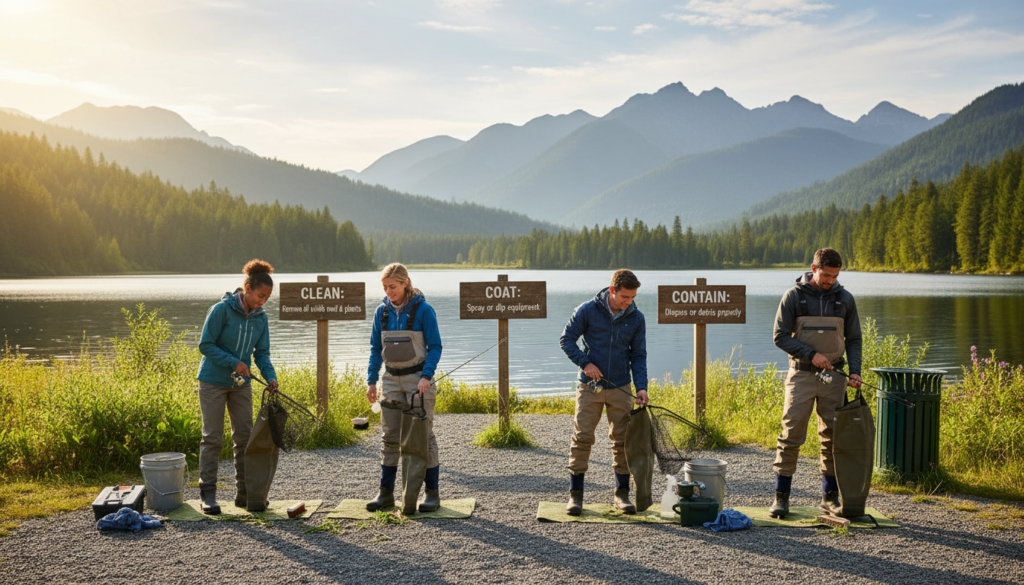
Cooperation asks anglers to model good practice and help peers follow the steps. Fisheries management offices are increasingly highlighting these values to support long‑term prevention.
- Make cleaning routine: inspect, rinse, drain, and dry.
- Share resources: coordinate local stations and training.
- Support one another: encourage stewardship at every outing.
“Simple, shared rules create big gains in protection with little burden on users.”
Bridging the Gap Between Awareness and Action
Turning knowledge into routine checks at the boat ramp takes more than signs and pamphlets.
Half of participants reported knowing about the New Zealand mudsnail, yet fewer than half cleaned their waders after a trip (52% aware; 44% cleaned). This mismatch shows that simple information does not always change on-the-ground angler choices.
To close the gap, outreach must push beyond facts and make the preferred behaviors easy, quick, and visible. Short prompts, on-site tools, and social nudges help participants adopt consistent steps between waters.
- Diagnose barriers: find time, space, and tool limits that stop action.
- Design for use: place rinse stations and clear checklists at launches.
- Measure results: track adoption and the ecological prevention impacts.
Effective management focuses on removing friction so each angler can practice the small steps that protect fisheries. When work targets real barriers, awareness becomes habit and prevention becomes the norm.
“Practical tools and simple prompts turn good intent into lasting behavior.”
Future Directions for Fisheries Management and Policy
Long-term success depends on regional agreements that align practices from the Mississippi River to the Great Lakes.
The study spanned 12 states, 1,042 counties, and 66 watersheds. That scale shows why local rules must fit a larger plan.
Policy must prioritize protection of native fish species across connected basins. Over the next year, agencies should set clear goals and measurable steps. New York and other states can lead by adopting consistent checklists and support tools at busy launches.
Management agencies need long-term regional cooperation. Regular information sharing and joint funding make prevention more effective than isolated actions.
- Standardize cleaning and inspection across the region, focusing on key corridors such as the Mississippi River.
- Create a multi-year roll-out that tracks progress by county and watershed.
- Support research that links travel data to outcomes for fish species and habitat health.
“Coordinated policy across states will offer the best protection for freshwater resources.”
Integrating these study findings into policy will strengthen fisheries management and boost prevention in the coming year.
Collaborative Efforts for Protecting Freshwater Ecosystems
Uniting local clubs, state offices, and federal managers creates a practical path to protect water and reduce gear-borne spread.
Across 12 states, 1,042 counties, and 66 watersheds, coordinated efforts give managers the best chance to limit spread. Shared data lets teams spot high-risk travel links and place tools where they matter most.
Joint management simplifies on-the-ground steps. When agencies align checklists and install rinse stations, routine checks of lines, boots, and boat wells become standard practice.
Fisheries protection needs a unified approach that includes individual users and large organizations. Working together builds capacity for training, audits, and targeted outreach.
- Share movement data to predict hot spots.
- Coordinate funding for cleaning infrastructure.
- Standardize protocols so prevention is clear and repeatable.
“Collaborative action turns many small choices into a strong defense for our water.”
Conclusión
The steady movement of people and gear links distant lakes and rivers into a shared risk network. ,
Millions of trips raise the chance that a single contaminated item will reach a new water body. Awareness alone does not always change behavior, so managers must make clean routines easy and visible.
Standardized decontamination and targeted, regional policy reduce ecological and economic harm. Agencies should fund rinse stations, clear checklists, and joint monitoring across states.
Protecting freshwater requires a sustained commitment. Practical rules and cooperation will help users, clubs, and offices turn good intent into lasting prevention.

 Spanish
  English